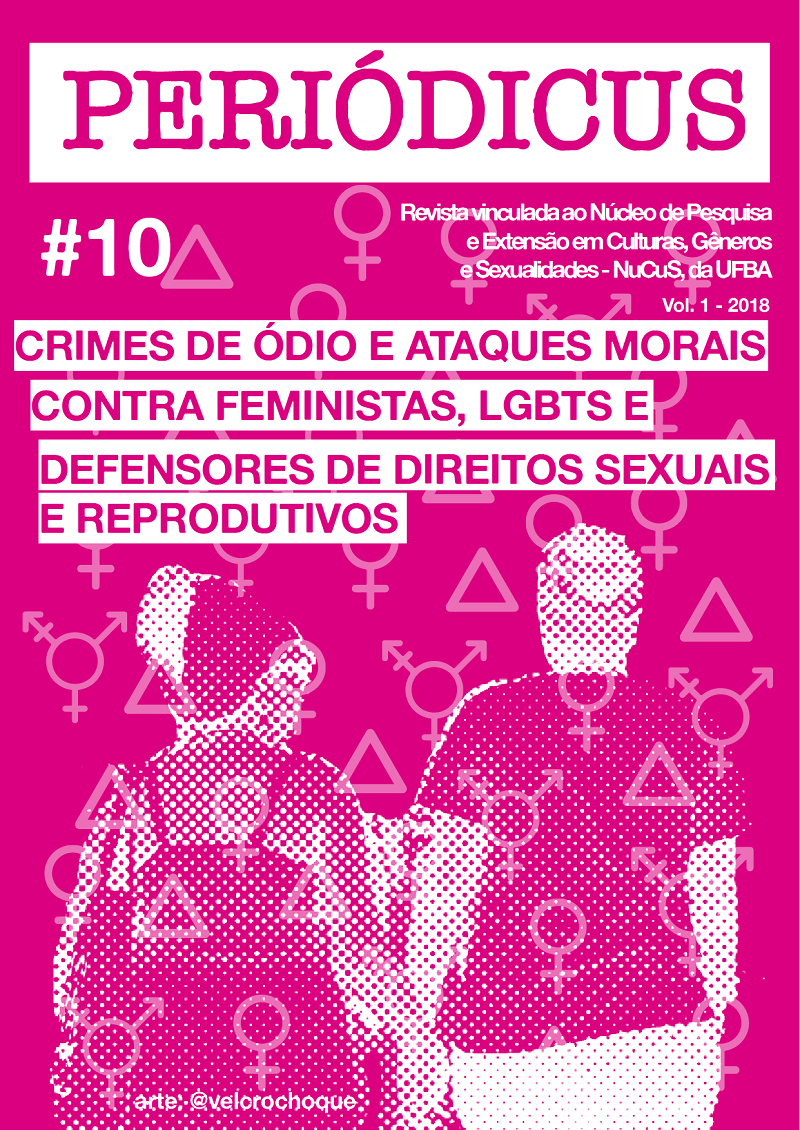
Lesbocídio: o estudo dos crimes de ódio contra lésbicas no Brasil
DOI:
https://doi.org/10.9771/peri.v1i10.28020Abstract
Resumo: O lesbocídio é uma expressão da lesbofobia que atinge seu nível letal. Compreender de que forma a lesbofobia leva ao lesbocídio é fundamental para vislumbrar como e quanto o ódio contra as lésbicas, em suas mais diversas expressões, é um mecanismo sistemático de opressão. Neste artigo buscamos apresentar diversas maneiras pelas quais os lesbocídios conectam-se aos contextos sociopolítico, cultural, religioso, misógino, lesbofóbico etc. em que eles ocorrem mostrando a importância do respaldo patriarcal para tais mortes. Por fim, defende-se que o aprofundamento dos estudos sobre lesbocídio podem colaborar com subsídios para a garantia dos direitos lésbicos e da existência e resistência lésbicas.
Palavras-chave: lesbocídio; invisibilidade lésbica; crimes de ódio; direitos lésbicos.
Downloads
Downloads
Published
How to Cite
Issue
Section
License
Copyright (c) 2018 Revista Periódicus

This work is licensed under a Creative Commons Attribution-NonCommercial 4.0 International License.
Authors who publish in this journal agree to the following terms:
Authors retain copyright and grant the journal the right of first publication, with the work simultaneously licensed under a Creative Commons Attribution Noncommercial License that allows the work to be shared with acknowledgment of authorship and initial publication in this journal, but prohibits commercial use.
Authors are authorized to enter into separate additional contracts for non-exclusive distribution of the version of the work published in this journal (e.g., publishing in an institutional repository or as a book chapter), with acknowledgment of authorship and initial publication in this journal.
Authors are permitted and encouraged to publish and distribute their work online (e.g., in institutional repositories or on their personal website) at any point before or during the editorial process, as this can generate productive changes and increase the impact and citation of the published work (see The Effect of Open Access).